A patient's guide to understanding why the shoulder dislocates, what the surgical options are, and how the right procedure is chosen.
This article is for educational purposes only. It is not a substitute for medical advice. Always consult your physician before starting or changing treatment.
Understanding the shoulder joint
The shoulder is the most mobile joint in the body — and that mobility comes at a cost. Unlike the hip, where a deep socket firmly holds the ball of the femur in place, the shoulder socket (glenoid) is remarkably shallow. The ball of the upper arm bone (humeral head) sits against this shallow socket the way a golf ball sits on a tee — held in place not by bone depth, but by the surrounding soft tissue.
Stability is maintained by a combination of soft tissue structures: the labrum, the glenohumeral ligaments, the joint capsule, and the rotator cuff muscles. The labrum is a ring of fibrocartilage attached to the rim of the glenoid that deepens the socket and serves as an anchor point for the ligaments.
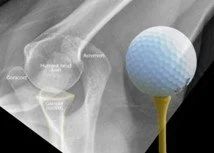
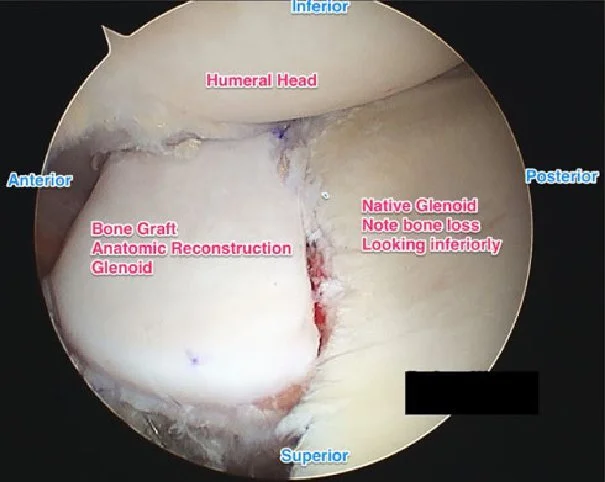
When the shoulder dislocates anteriorly — the most common direction — the humeral head slips forward out of the socket. This almost always damages the anterior labrum and the ligaments attached to it. It may also create a dent in the back of the humeral head (a Hill-Sachs lesion) and, in more severe cases, chip away bone from the front of the glenoid.
Why does the shoulder dislocate?
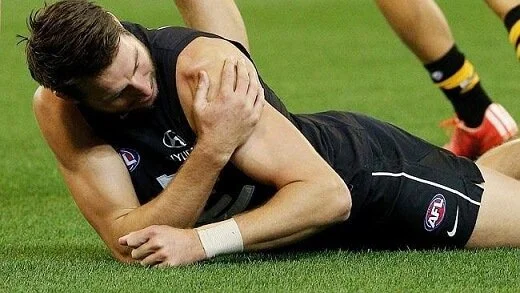
First-time shoulder dislocations most commonly occur during sport — a fall on an outstretched arm, a tackle, or a forced external rotation of the arm. Contact sports such as football, rugby, lacrosse, and wrestling carry the highest risk.
Once the shoulder has dislocated, the torn labrum and stretched ligaments do not reliably heal back to their original position and tension. The shoulder becomes mechanically unstable — and the risk of a second dislocation is high, particularly in younger, active patients.
Studies show that in patients under 25 who return to sport after a first dislocation without surgery, recurrence rates exceed 70%. In athletes under 20, the rate approaches 90%. This is the central argument for early surgical stabilization in young active patients.
Non-surgical management
Not all patients with shoulder instability require surgery. Older, lower-demand patients who experience a first-time dislocation — particularly if they are willing to modify their activities — can often be managed successfully with physical therapy.
Non-surgical treatment focuses on:
• Restoring range of motion after the acute dislocation
• Strengthening the rotator cuff and periscapular muscles to provide dynamic stability
• Proprioceptive retraining — restoring the shoulder's position sense
• Activity modification to avoid high-risk positions
If a patient experiences recurrent instability despite rehabilitation, or if the risk of recurrence is high given their age and activity level, surgical stabilization is the appropriate next step.
When surgery is considered
Surgical stabilization is typically recommended in the following situations:
• Young athletes (under 25) with a first-time traumatic dislocation, particularly in contact or overhead sports
• Any patient with recurrent instability despite a trial of physical therapy
• Patients with significant bone loss from the glenoid or humeral head
• Patients whose instability is causing functional limitations in daily life or work
The goal of surgery is to restore the mechanical stability of the shoulder — repairing the torn tissue, re-tensioning the capsule, and in some cases augmenting with bone — so the patient can return to full activity with a low risk of re-dislocation.
Surgical options
Several well-established procedures exist for anterior shoulder instability. The right choice depends on the degree of bone loss, the patient's activity level and sport, and whether prior surgery has been performed.
Bankart repair
The Bankart repair is the most commonly performed procedure for anterior shoulder instability and is the standard of care for patients without significant bone loss.
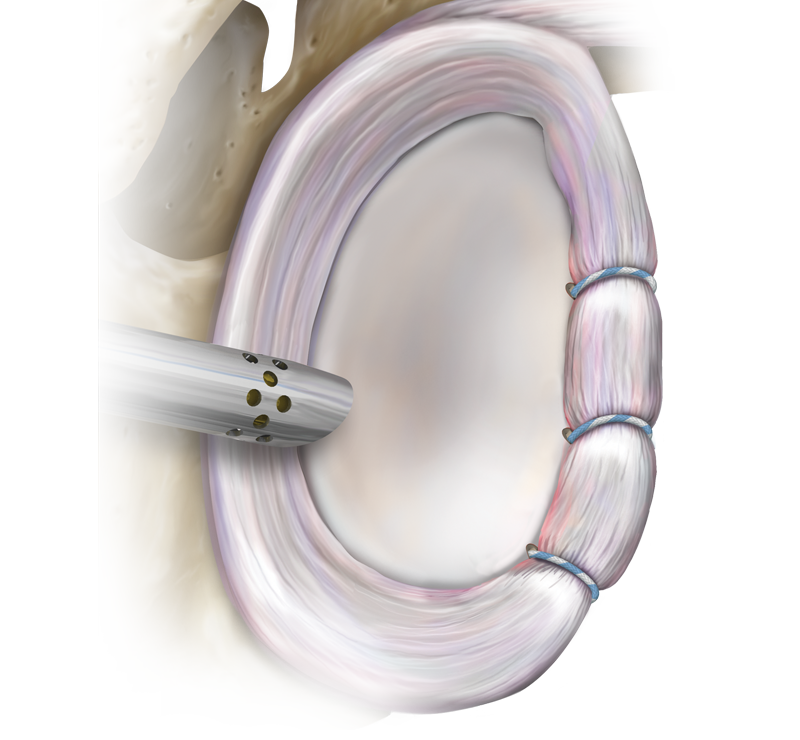
The torn anterior labrum is reattached to the glenoid rim using suture anchors — small devices inserted into the bone that tie the tissue back down. The capsule is tightened at the same time. Performed arthroscopically. Return to sport typically at 6 to 9 months.
Remplissage
Performed alongside a Bankart repair when a Hill-Sachs lesion is large enough to engage with the front of the glenoid during movement. The posterior capsule and infraspinatus tendon are anchored into the defect, filling it and preventing engagement. May slightly reduce external rotation.
Latarjet procedure
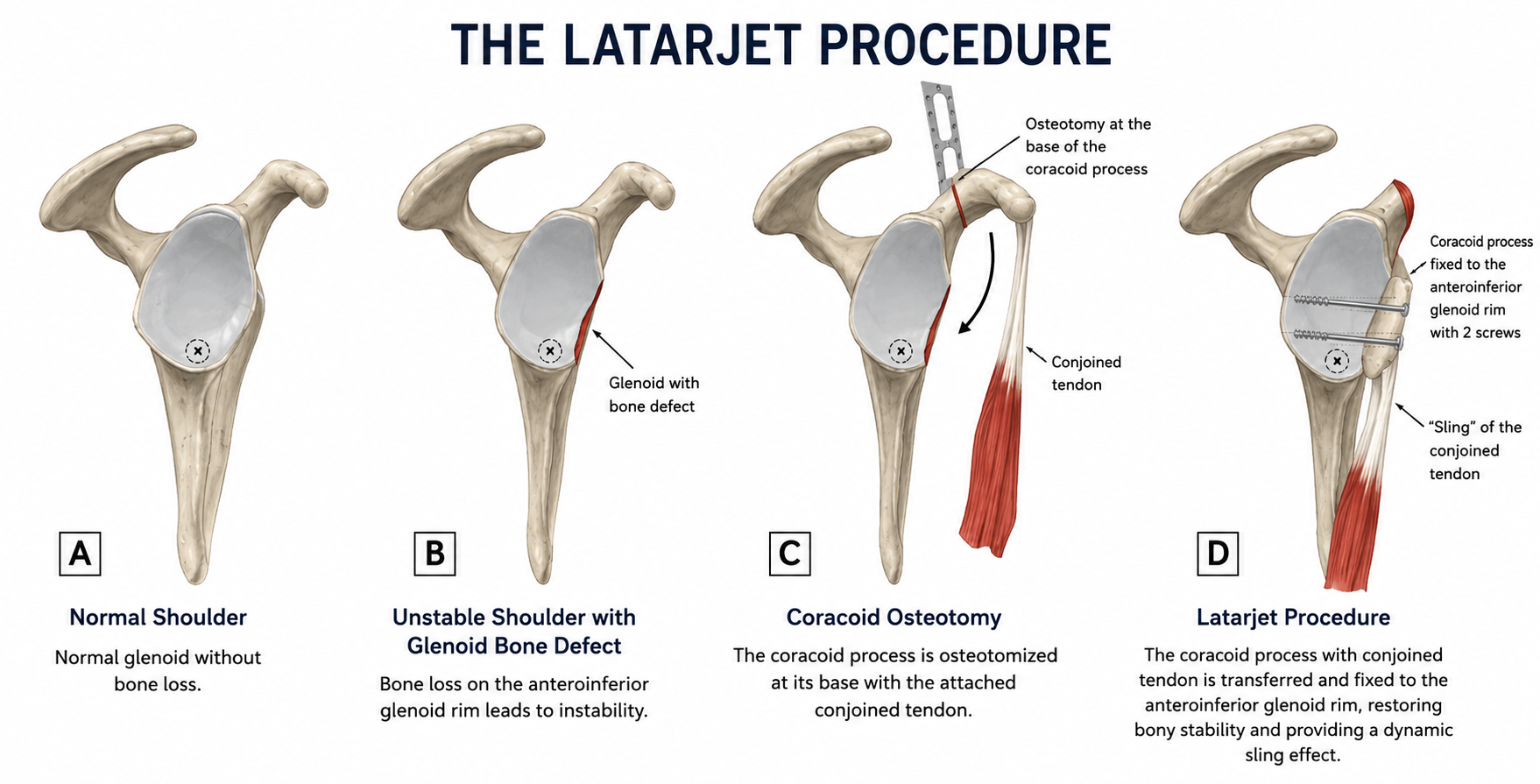
The treatment of choice when significant glenoid bone loss is present or when a Bankart repair has previously failed. The coracoid process is transferred to the front of the glenoid and secured with screws — restoring bony surface area and creating a dynamic sling via the conjoined tendon. Return to contact sport at 9 to 12 months.
Distal tibial allograft (DTA)
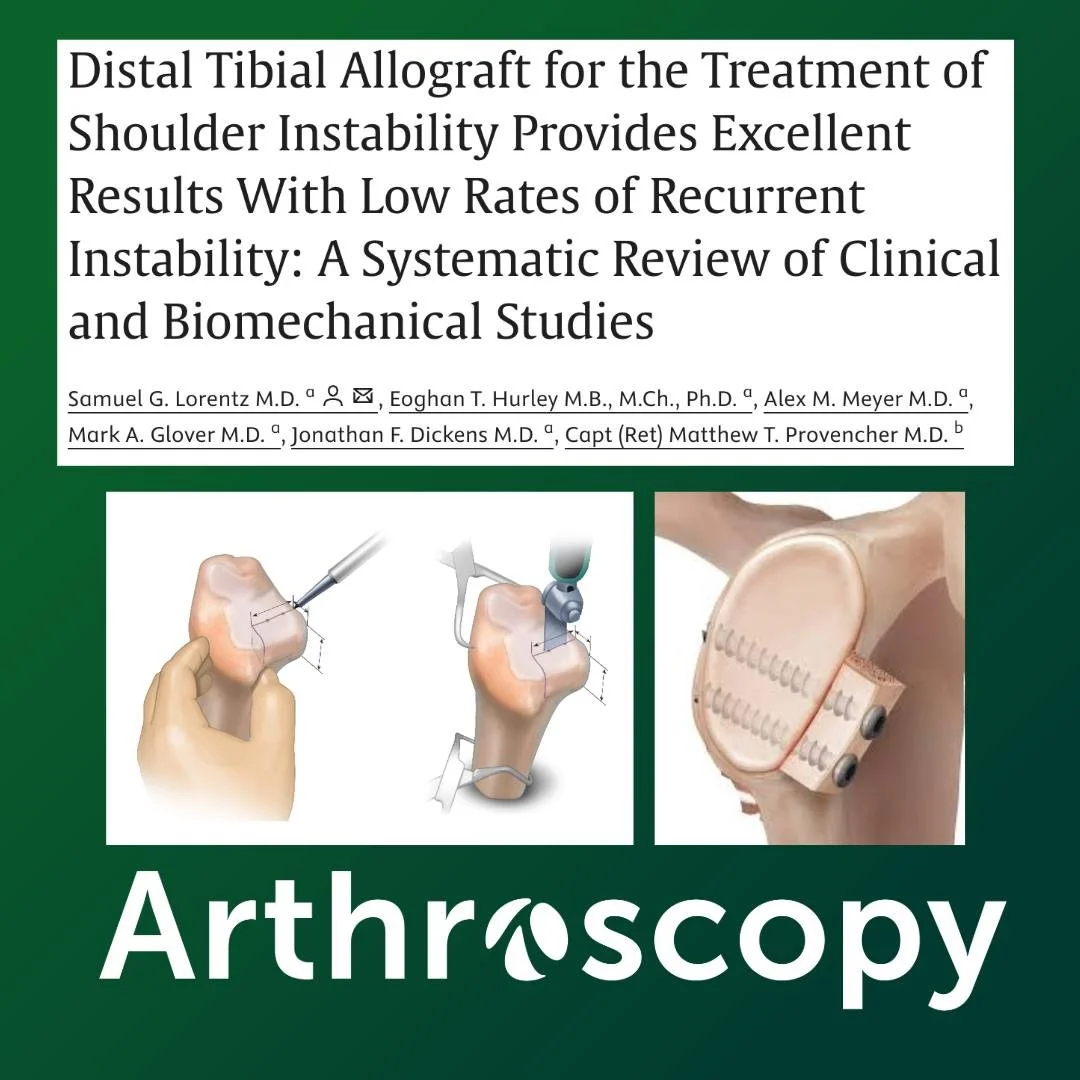
Used when glenoid bone loss is severe or when a prior Latarjet has failed. A precisely shaped graft of donor bone from the distal tibia reconstructs the glenoid surface. Can be performed open or arthroscopically.
How the right procedure is chosen
The decision depends on:
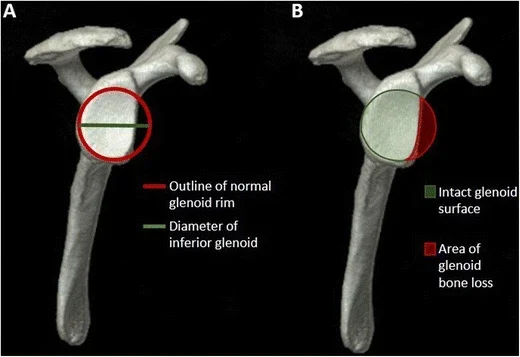
• Degree of bone loss. CT with 3D reconstruction measures glenoid bone loss. Minimal → Bankart. Moderate to significant → Latarjet. Severe or revision → DTA.
• Hill-Sachs lesion. Size and position determine whether remplissage is needed.
• Patient age and sport. Young contact athletes may benefit from more robust stabilization upfront.
• Prior surgery. A failed Bankart repair often means a bony procedure is required.
What recovery looks like
• Weeks 1–4: Sling immobilization. Gentle pendulum exercises.
• Weeks 4–12: Progressive range of motion. Rotator cuff activation. Scapular strengthening.
• Months 3–6: Strength training. Sport-specific conditioning.
• Months 6–9 (Bankart/remplissage): Return to full contact sport after objective criteria are met.
• Months 9–12 (Latarjet/DTA): Return to full contact sport. Bone healing confirmed on imaging before clearance.
Summary
Anterior shoulder instability is a mechanical problem that requires a mechanical solution. The right procedure depends on a thorough assessment of bone loss, the patient's sport and activity demands, and surgical history. For the right patient, modern shoulder stabilization procedures provide excellent long-term outcomes and reliable return to sport at all levels.
References
Owens BD, Duffey ML, Nelson BJ, DeBerardino TM, Taylor DC, Mountcastle SB. The incidence and characteristics of shoulder instability at the United States Military Academy. Am J Sports Med. 2007;35(7):1168-1173. doi:10.1177/0363546506295179
Hovelius L, Rahme H. Primary anterior dislocation of the shoulder: long-term prognosis at the age of 40 years or younger. Knee Surg Sports Traumatol Arthrosc. 2016;24(2):330-342. doi:10.1007/s00167-015-3980-2
Olds M, Ellis R, Donaldson K, Parmar P, Kersten P. Risk factors which predispose first-time traumatic anterior shoulder dislocations to recurrent instability in adults: a systematic review and meta-analysis. Br J Sports Med. 2015;49(14):913-922. doi:10.1136/bjsports-2014-094342
Cordischi K, Li X, Busconi B. Intermediate outcomes after primary traumatic anterior shoulder dislocation in skeletally immature patients aged 10 to 13 years. Orthopedics. 2009;32(9):686-690. doi:10.3928/01477447-20090728-34
Ellis HB Jr, Seiter M, Wise K, Wilson P. Glenoid bone loss in traumatic glenohumeral instability in the adolescent population. J Pediatr Orthop. 2017;37(1):30-35. doi:10.1097/BPO.0000000000000586
Longo UG, van der Linde JA, Loppini M, Coco V, Poolman RW, Denaro V. Surgical versus nonoperative treatment in patients up to 18 years old with traumatic shoulder instability: a systematic review and quantitative synthesis of the literature. Arthroscopy. 2016;32(5):944-952. doi:10.1016/j.arthro.2015.10.020
De Carli A, Vadalà AP, Lanzetti R, et al. Early surgical treatment of first-time anterior glenohumeral dislocation in a young, active population is superior to conservative management at long-term follow-up. Int Orthop. 2019;43(12):2799-2805. doi:10.1007/s00264-019-04382-2
Warner T, Kay J, McInnis S, Heyworth BE. Risk factors for recurrent instability after arthroscopic Bankart repair in pediatric and adolescent patients: a systematic review. Am J Sports Med. 2025;53(6):1494-1504. doi:10.1177/03635465241267022
Rossi LA, Tanoira I, Bruchmann MG, Pasqualini I, Ranalletta M. The Latarjet procedure in competitive athletes younger than 20 years old with significant glenoid bone loss. Shoulder Elbow. 2022;14(1 Suppl):21-28. doi:10.1177/1758573220944166
Bonazza NA, Riboh JC. Management of recurrent anterior shoulder instability after surgical stabilization in children and adolescents. Curr Rev Musculoskelet Med. 2020;13(2):164-172. doi:10.1007/s12178-020-09612-4
Rowe CR, Patel D, Southmayd WW. The Bankart procedure: a long-term end-result study. J Bone Joint Surg Am. 1978;60(1):1-16.
Kirkley A, Griffin S, McLintock H, Ng L. The development and evaluation of a disease-specific quality of life measurement tool for shoulder instability: the Western Ontario Shoulder Instability Index (WOSI). Am J Sports Med. 1998;26(6):764-772. doi:10.1177/03635465980260060501
Fuchs B, Jost B, Gerber C. Posterior-inferior capsular shift for the treatment of recurrent, voluntary posterior subluxation of the shoulder. J Bone Joint Surg Am. 2000;82(1):16-25. doi:10.2106/00004623-200001000-00003
Williams GN, Gangel TJ, Arciero RA, Uhorchak JM, Taylor DC. Comparison of the Single Assessment Numeric Evaluation method and two shoulder rating scales: outcome measures after shoulder surgery. Am J Sports Med. 1999;27(2):214-221. doi:10.1177/03635465990270021701
Nassar R, Khayyat N, Halasa M, Hussain F. Traumatic anterior shoulder instability: a narrative review of current literature. Georgian Med News. 2025 Jul-Aug;(364-365):46-50. PMID: 41072493.
James C. Messina, MD
Orthopedic Surgery · Sports Medicine · NYU Langone Long Island
Commack, NY · 631-919-6262
Disclaimer: This article is for educational purposes only and does not constitute medical advice. Consult a qualified physician for evaluation and treatment of any medical condition.
