Understanding corticosteroids, hyaluronic acid, PRP, and bone marrow concentrate, what each is, what the evidence shows, and how to choose.
This article is for educational purposes only. It is not a substitute for medical advice. Always consult your physician before starting or changing treatment.
Overview, what are biologic injections?
The term "biologic injection" covers a broad range of substances injected into or around a joint to manage pain, reduce inflammation, or support tissue healing. They range from well-established treatments with decades of clinical data to newer regenerative therapies whose evidence base is still evolving.
Understanding the differences between these options, what each does, what the evidence actually supports, and where the limitations lie, helps patients have a more informed conversation with their physician and make better decisions about their care.
The four main categories used in orthopedic practice are: corticosteroids, hyaluronic acid (gel injections), platelet-rich plasma (PRP), and bone marrow concentrate (BMAC).
Corticosteroid injections
What they are
Corticosteroids are synthetic versions of cortisol, a hormone produced naturally by the adrenal glands that plays a central role in regulating inflammation. When injected directly into a joint or soft tissue, corticosteroids deliver a powerful, targeted anti-inflammatory effect that can significantly reduce pain and swelling.
Corticosteroid injections are among the most commonly performed procedures in orthopedic medicine and have a well-established evidence base for short-term pain relief across a wide range of conditions, including osteoarthritis, bursitis, tendinopathy, and impingement syndromes.
What the evidence shows
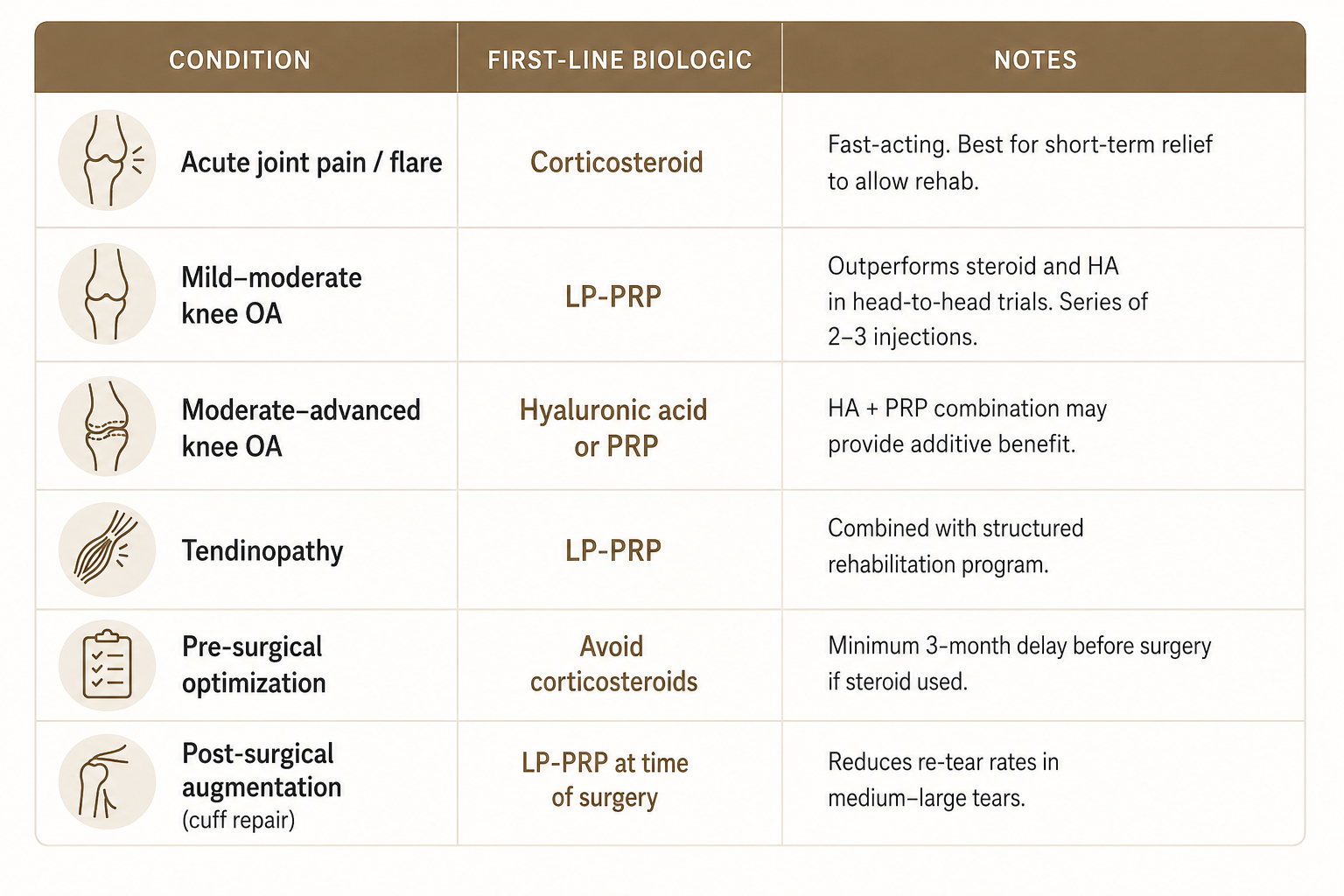
Corticosteroids work quickly, most patients experience meaningful pain relief within 24 to 72 hours. The relief is real and often substantial, but it is typically temporary. For most conditions, the effects last weeks to months rather than years.
They are most appropriate as a bridging strategy: providing enough pain relief to allow a patient to engage effectively in physical therapy, or to get through a specific period of high demand. It is not a long-term solution.
Important limitations
Repeated injections can damage tissue. Multiple corticosteroid injections into the same site over time can weaken tendons, thin cartilage, and accelerate joint degeneration. Most guidelines recommend no more than three to four injections per year at the same site.
The 3-month surgical delay. If surgery is being contemplated, a corticosteroid injection into the operative site requires a minimum 3-month delay before proceeding. Steroids affect tendon tissue quality and increase infection risk, both of which impact surgical outcomes.
Blood sugar effects. Corticosteroids can temporarily raise blood glucose levels, an important consideration for diabetic patients, who should monitor closely after injection.
Not a cure. Corticosteroids reduce inflammation but do not address the underlying structural problem. Pain relief without behavioral modification or rehabilitation typically results in recurrence.
Hyaluronic acid (gel injections)
What they are
Hyaluronic acid is one of the main components of synovial fluid, the natural lubricant inside joints. It gives synovial fluid its viscous properties that allow smooth joint movement and cushion impact. In arthritic joints, the concentration and quality of hyaluronic acid decline over time.
Gel injections, also called viscosupplementation, involve injecting synthetic or purified hyaluronic acid directly into the joint to supplement the natural fluid and restore some of its lubricating properties.
What the evidence shows
The evidence for hyaluronic acid is more nuanced than for corticosteroids. It does not work as quickly and the magnitude of pain relief is generally more modest, but it may last longer, with some patients reporting benefit for 6 to 12 months.
It performs best in mild to moderate knee osteoarthritis. In advanced arthritis, results are less predictable. It is particularly useful for patients who cannot tolerate repeated corticosteroid injections or who want to avoid steroids for other reasons.
Recent evidence also suggests that combining hyaluronic acid with PRP may provide a synergistic effect, the two together outperforming either alone in some trials. This combination is an area of active clinical interest.
Practical considerations
Hyaluronic acid injections are typically given as a series, one to three injections over consecutive weeks, depending on the preparation used. They are generally well tolerated, though some patients experience temporary post-injection flare in the first 24 to 48 hours.
Not all insurance plans cover viscosupplementation. This is worth verifying before proceeding, as out-of-pocket costs can be significant.
Platelet-rich plasma (PRP)
What it is
Platelet-rich plasma is derived from the patient's own blood. A blood sample is drawn, placed in a centrifuge, and spun to separate its components. Red blood cells, heavier than the rest, settle to the bottom. The upper layer consists of plasma and platelets, which are then concentrated and prepared for injection.
Platelets transport over 1,500 proteins, including growth factors stored in small structures called alpha-granules. These growth factors play key roles in tissue healing, stimulating cell proliferation, collagen production, and the recruitment of repair cells to the injury site.
PRP preparations, why they differ
Not all PRP is the same. The composition of PRP varies considerably based on the centrifuge system used, the number of spins, and whether white blood cells (leukocytes) are included or excluded.
Leukocyte-poor PRP (LP-PRP), white cells are largely removed. This preparation is generally preferred for intra-articular injections, as high white cell concentrations can cause more inflammatory reactions inside joints.
Leukocyte-rich PRP (LR-PRP), white cells are retained. This may be more appropriate for tendon or soft tissue applications where some inflammatory response is beneficial to healing.
The specific preparation matters, studies comparing different PRP types in the same condition sometimes show divergent results, which is part of why the overall PRP literature can appear inconsistent.
What the evidence shows
PRP has the most established evidence base for the following applications:
Knee osteoarthritis. A 2025 meta-analysis by Bensa and colleagues in the American Journal of Sports Medicine — pooling 18 randomized controlled trials and 1,995 patients — demonstrated that PRP provides both statistically significant and clinically meaningful improvements in pain and function compared to placebo at 1, 3, 6, and 12 months. Crucially, platelet concentration was found to significantly influence outcomes: high-platelet PRP (above 1,000,000 platelets per microliter) provided durable pain relief exceeding the minimum clinically important difference at 3, 6, and 12 months, while low-platelet PRP failed to reach that threshold for pain relief at any time point. Both maintained functional improvement at 3 and 6 months, but only high-platelet PRP sustained that benefit at 12 months.
Tendinopathy. PRP has supporting evidence for chronic tendinopathy, particularly lateral epicondylitis (tennis elbow), patellar tendinopathy, and rotator cuff tendinopathy, where it appears to stimulate collagen remodeling in degenerative tendon tissue.
Rotator cuff repair augmentation. When applied at the time of surgical repair, leukocyte-poor PRP reduces re-tear rates in medium to large rotator cuff tears.
Important caveat: PRP improves symptoms in osteoarthritis. It does not regenerate or regrow cartilage. No clinical studies have demonstrated cartilage healing from PRP injection. The mechanism is symptom modification, not structural repair.
Platelet concentration matters — a practical implication
The Bensa 2025 meta-analysis has a direct clinical implication that patients rarely know to ask about: not all PRP is the same. The system used to prepare PRP, the centrifuge speed, and the number of processing steps all affect the final platelet count. A higher platelet concentration delivers more growth factors and produces more durable results. When discussing PRP with your physician, it is worth asking what system is used and what platelet concentration is typically achieved.
How many injections?
For early osteoarthritis, a series of two to three injections spaced two to four weeks apart is generally more effective than a single injection. For tendinopathy, one to two injections with a structured rehabilitation program is the typical protocol. Annual re-injection may be appropriate for patients who respond well.
Bone marrow concentrate (BMAC)
What it is
Bone marrow concentrate, also called BMAC or BMC, is obtained by aspirating bone marrow, typically from the posterior iliac crest (the back of the pelvis). The aspirate is then centrifuged to concentrate its components, which include growth factors, cytokines, and a small number of mesenchymal stem cells with osteoprogenitor potential.
BMAC is sometimes marketed as a stem cell injection, and that framing deserves some clarification. While bone marrow does contain mesenchymal stem cells, cells with the potential to differentiate into bone, cartilage, or fat, the concentration of true stem cells in BMAC is small, and their survival and activity after injection is not uniformly established. The growth factors and osteoprogenitor cells it delivers are likely more relevant to its clinical effects than the stem cell component in isolation.
Where the evidence is strongest, OCA transplantation
The most compelling evidence for BMAC in orthopedics comes from its use as an adjunct to osteochondral allograft (OCA) transplantation, not as a standalone injection, but as a biological enhancer of bone healing at the graft-recipient interface.
A 2025 prospective, randomized, double-blind controlled trial by Yanke and colleagues, the highest level of clinical evidence, compared OCA grafts soaked in BMAC prior to implantation versus OCA alone. The BMAC group demonstrated significantly fewer large cystic changes at the graft-recipient interface on CT scan at 6 months, and significantly fewer reoperations and clinical failures. Patient-reported outcomes did not differ significantly between groups at final follow-up, though the structural and radiographic benefit was clear.
This finding makes biological sense. The primary requirement for OCA success is osseous integration, the bone component of the graft healing into the recipient site. BMAC's osteoprogenitor cells and growth factors are well-suited to support this specific biological process. This is a different mechanism than BMAC's use in soft tissue applications, where results have been more variable.
BMAC has also shown capacity to promote tendon healing in rotator cuff repair and accelerate graft ligamentization in ACL reconstruction, though in those applications the patient-reported outcome benefit has been less consistent.
As a standalone injection
Outside of surgical augmentation, BMAC as a standalone injection for conditions such as knee osteoarthritis has a less compelling evidence base than PRP. Head-to-head comparisons do not consistently show BMAC to outperform PRP, and it is a more invasive procedure, requiring marrow aspiration under local anesthesia, with higher procedural cost and generally no insurance coverage.
BMAC has a meaningful and growing evidence base for specific surgical applications, particularly where bone healing and integration are the primary goal. As a standalone injection for pain management, the evidence is less differentiated from PRP to justify its additional complexity and cost in most patients.
How to choose, a practical framework
What biologic injections cannot do
This is perhaps the most important section of this article. Biologic injections are tools for symptom management and, in some applications, biological support of healing. They are not cures. They do not repair structural damage, reverse arthritis, or substitute for surgery when surgery is indicated.
Biologic injections work best as part of a broader treatment plan, not as a substitute for one.
Summary
Biologic injections span a spectrum from well-established (corticosteroids, hyaluronic acid) to evidence-supported for specific indications (PRP) to still-investigational in human populations (BMAC). Each has a role when matched to the right patient, the right condition, and the right stage of disease.
The most important principle is that these injections should be part of a conversation about the overall treatment plan, not a standalone decision made in isolation.
References
Bensa A, Previtali D, Sangiorgio A, et al. PRP injections for the treatment of knee osteoarthritis: the improvement is clinically significant and influenced by platelet concentration. A meta-analysis of randomized controlled trials. Am J Sports Med. 2025;53(3):745-754.
Yanke AB, Dandu N, Bodendorfer BM, et al. Bone marrow aspirate concentrate may decrease reoperation in osteochondral allograft transplantation: a prospective, randomized, double-blind investigation. Arthroscopy. 2025;41:4664-4673.
Sheean AJ. Editorial commentary: the use of bone marrow aspirate concentrate in osteochondral allograft transplantation decreases the presence of large cystic changes at the graft-recipient site interface. Arthroscopy. 2025;41:4674-4676.
James C. Messina, MD
Orthopedic Surgery · Sports Medicine · NYU Langone Long Island
Commack, NY · 631-919-6262
